
4-in-1 AI Assistant Copywriter

Multi-purpose n8n AI assistant that ingests reviewer reports, drafts response and cover letters, and scaffolds funding proposals and manuscript narratives from PDFs, emails, and cloud storage in one unified workflow.

Multi-purpose n8n AI assistant that ingests reviewer reports, drafts response and cover letters, and scaffolds funding proposals and manuscript narratives from PDFs, emails, and cloud storage in one unified workflow.

Multi-purpose n8n AI assistant that ingests reviewer reports, drafts response and cover letters, and scaffolds funding proposals and manuscript narratives from PDFs, emails, and cloud storage in one unified workflow.

About the project

This project extends a simple reviewer response generator into a full-stack AI copilot for academic writing and publication workflows. The automation listens to reviewer emails, decision letters, uploaded PDFs, and manual webhook requests, then routes the content into specialized AI routines: point-by-point response letters, journal cover letters, funding proposal outlines, and structured summaries of manuscript contributions. Researchers can quickly move from raw reviewer feedback or draft manuscripts to high-quality, structured documents tailored to different stakeholders (editors, reviewers, funders).

This project extends a simple reviewer response generator into a full-stack AI copilot for academic writing and publication workflows. The automation listens to reviewer emails, decision letters, uploaded PDFs, and manual webhook requests, then routes the content into specialized AI routines: point-by-point response letters, journal cover letters, funding proposal outlines, and structured summaries of manuscript contributions. Researchers can quickly move from raw reviewer feedback or draft manuscripts to high-quality, structured documents tailored to different stakeholders (editors, reviewers, funders).

This project extends a simple reviewer response generator into a full-stack AI copilot for academic writing and publication workflows. The automation listens to reviewer emails, decision letters, uploaded PDFs, and manual webhook requests, then routes the content into specialized AI routines: point-by-point response letters, journal cover letters, funding proposal outlines, and structured summaries of manuscript contributions. Researchers can quickly move from raw reviewer feedback or draft manuscripts to high-quality, structured documents tailored to different stakeholders (editors, reviewers, funders).

Date:

Mar 9, 2025

Client:

Sam Byers

Services:
Project Details

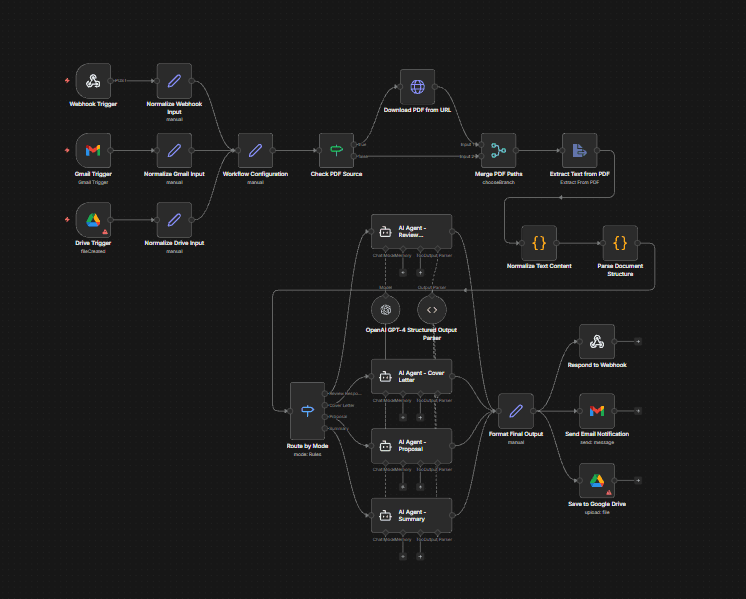
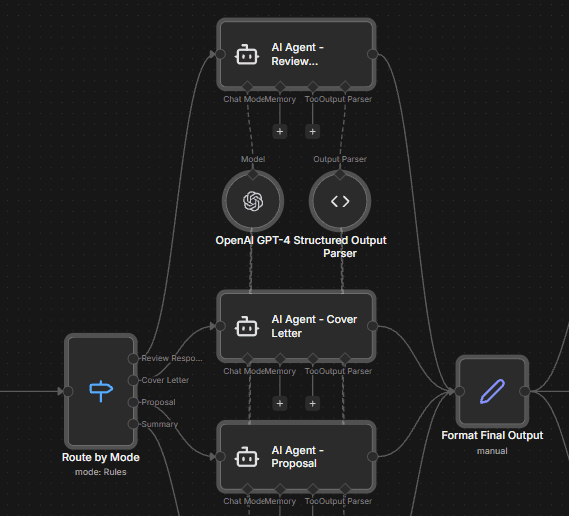
The workflow is driven by three main triggers: a webhook endpoint for API/front-end submissions, a Gmail trigger that watches labels like “reviewer comments” and “decision letter,” and a Google Drive trigger that monitors a shared “Reviews & Grants” folder. After consolidating metadata (source, filename, PDF URL, email subject), the system downloads PDFs when needed, extracts text, and runs a parsing layer that identifies reviewer sections, bullet comments, editor summaries, or proposal-relevant sections. The parsed content is passed into a configurable AI layer powered by GPT-4, where different prompt templates can be selected via workflow options or input flags:​

  • Reviewer response mode: generates structured, point-by-point author responses with placeholders for specific changes.​

  • Cover letter mode: creates a concise, journal-appropriate cover letter summarizing novelty, significance, and fit to the target journal.​

  • Funding proposal mode: builds a proposal scaffold (aims, background, significance, innovation, approach) from manuscript or notes, giving researchers a starting structure to expand.​

  • Summary mode: produces lay and technical summaries that can be reused in abstracts, impact statements, or fellowship applications. The workflow can return the generated text via webhook, store drafts in Google Drive or Notion, or email outputs back to the author for refinement.

“I was skeptical at first because I like to write my own stuff, but this AI helper has become my central academic writing assistant—I use it for response letters, cover letters, and to spin up first drafts of grant proposals in minutes. Then I personalize at will.”

Matilde Aragão

PhD Student

Things I Did

I built a modular AI assistant architecture with multiple document-generation modes driven by simple flags or endpoints. I extended the parsing logic to recognize not only reviewer comments but also editorial summaries and proposal-relevant sections in uploaded PDFs and emails. I designed distinct GPT-4 prompt templates for response letters, journal cover letters, and funding proposal scaffolds, ensuring each mode follows appropriate tone, structure, and conventions. I wired flexible outputs so results can be returned via API, emailed to authors, or saved into writing repositories, turning the workflow into a reusable backbone for academic communication automation.
Create a free website with Framer, the website builder loved by startups, designers and agencies.